Logo Kingdom of the Netherlands
 

Sarah Oppenheimer’s “RR”: between the US and the Netherlands

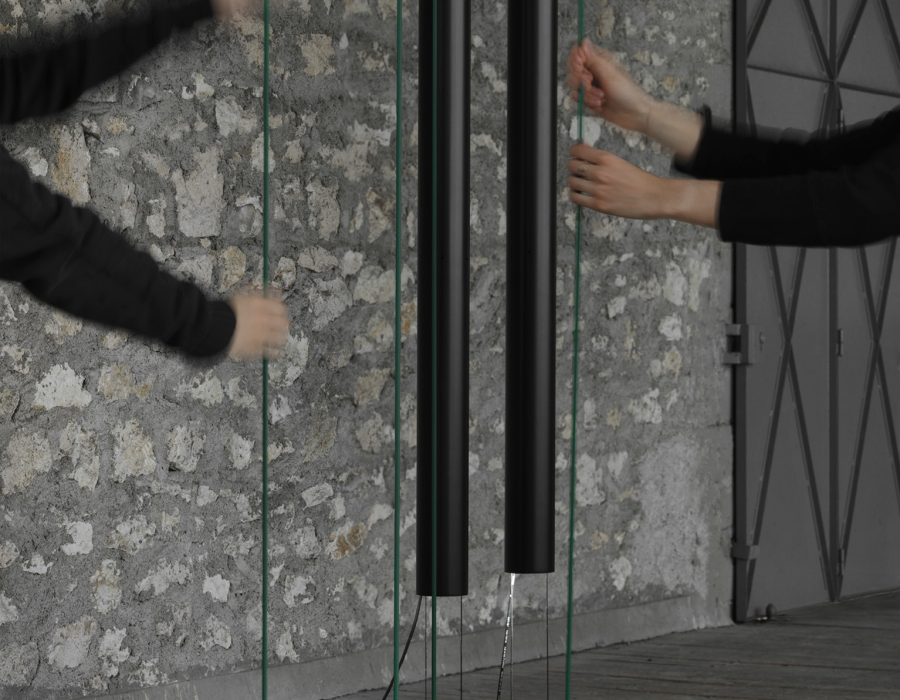
Night view of a modern glass-fronted building with illuminated interior showing a silhouette of a person walking inside nearby a parked car on a quiet street.
Sarah Oppenheimer. “RR", in development, 2025. V2_, Lab for the Unstable Media, Rotterdam. Photo by Paul Swagerman

"RR" is a tool, an object, a process—a responsive system of inputs and outputs that explores our perception of spatial agency. Artist Sarah Oppenheimer has developed multiple media platforms to implement this participatory engagement in both the US and the Netherlands.

Our environment contains us, and its machines maintain us, forming an intertwined ecosystem of context and habitation. How might our presence within these systems reshape their hierarchies and interdependencies? How might time be stretched or contracted, synchronized or offset, to amplify our sense of interconnection?

“RR” is a tool, an object, a process—a responsive system of inputs and outputs that explores our perception of spatial agency. Artist Sarah Oppenheimer has developed multiple media platforms to implement this participatory engagement in both the US and the Netherlands.

This February, a dialogue around “RR” will be presented at Yale University’s Center for Collaborative Arts and Media (CCAM) as part of CCAM Fest: Fluxus, the 2026 edition of CCAM’s interdisciplinary arts festival.

“RR: in Dialogue” will take place on Wednesday, February 25 at 6:30pm at CCAM, 149 York Street in New Haven, Connecticut, and will situate the project between the trajectories of Fluxus and media art. It will feature Oppenheimer and guests: Fabian Saavedra Lara (V2_, Lab for the Unstable Media, Netherlands), Hannah Higgins (University of Illinois Chicago), and Wouter Davidts (Ghent University, Belgium).

The CCAM event is in conversation with a presentation of “RR” as work in progress at V2_, Lab for the Unstable Media in Rotterdam on March 20 at 7pm CET, as part of their Tryday series. The Tryday event follows a development residency at V2_. After continued production in Rotterdam at Voorhaven 57, “RR” will tour for full presentations at The Arts Club Chicago and Tufts University Art Galleries in 2027.

Sarah Oppenheimer is an architectural manipulator whose work explores the emergent relations between human and non-human systems. Rhythms and timescales of living systems flow from body to building and back again. The viewer is transformed into an agent of spatial change. Oppenheimer lives and works in Rotterdam, The Netherlands and New York, US, and is a Professor in the Practice at Yale School of Art.

“RR” is developed with the support of international partners including: EPFL-CDH Enter the Hyper-Scientific (CH), Atelier Calder (FR), the Yale Center for Collaborative Arts and Media (CCAM) (US), V2_, Lab for the Unstable Media (NL), InteSpring (NL), TU Delft (NL), The Arts Club of Chicago (US), Tufts University Art Galleries (US), and the MIT School of Architecture and Planning (US).
A person standing in a spacious stone-walled room with large windows and high ceilings interacting with modern hanging black sculptures in an art installation.
Sarah Oppenheimer, "N-04008", 2024. Installation view: Atelier Calder. Photos by Serge Hasenböhler.
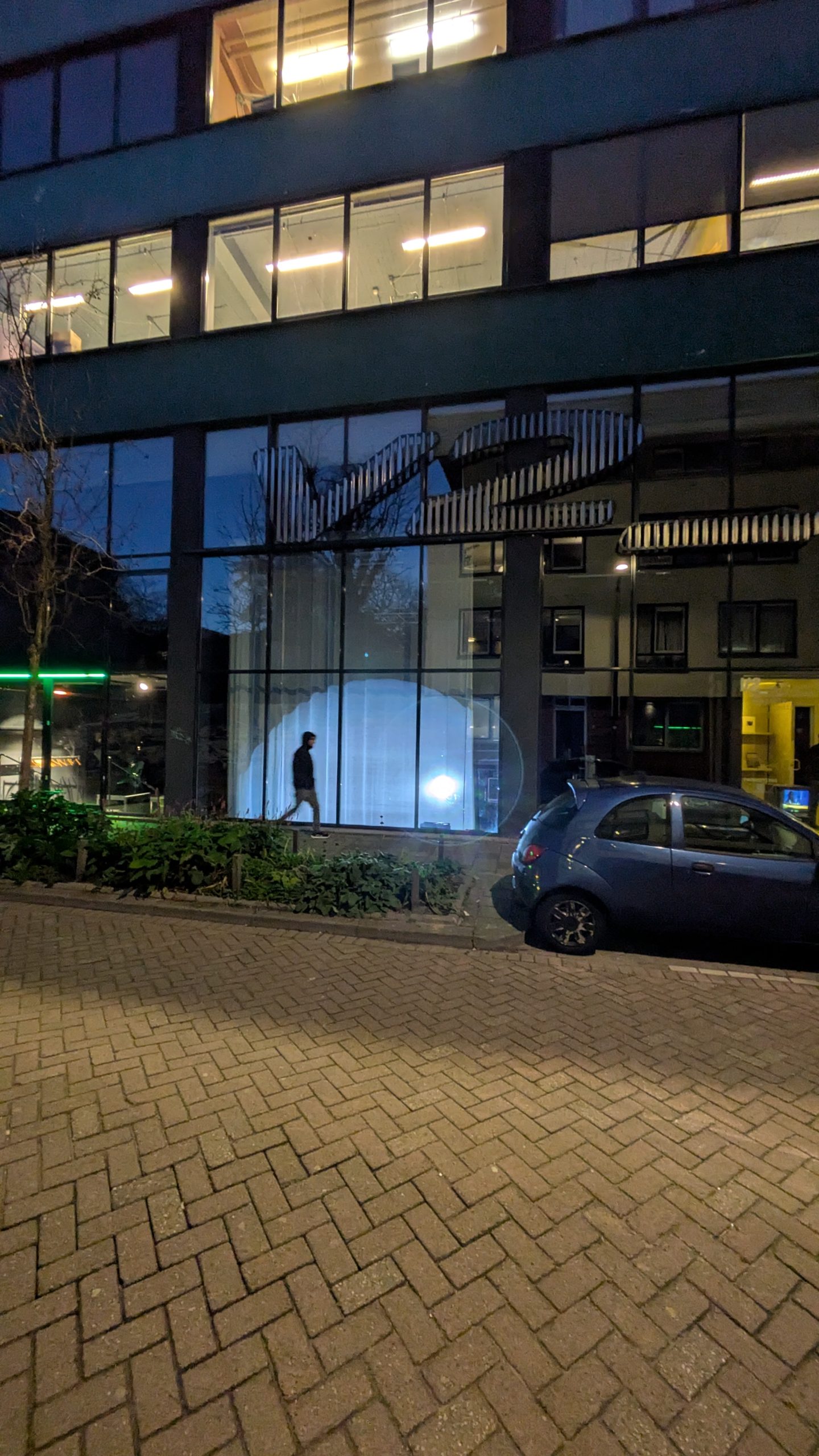
Two people interact with vertical black tubes suspended from strings in an industrial-style space with a stone wall and modern design elements.
Sarah Oppenheimer, "N-04008", 2024. Installation view: Atelier Calder. Photos by Serge Hasenböhler.

More about “RR”

Slender, floor-to-ceiling conductive lines form the primary interface for audience participants. Stretched across the architecture, their metallic cores act as distributed antennas, amplifying the electromagnetic frequencies of human presence through capacitance-sensing technology. The inputs register proximity and touch, transmitting signals to kinetic outputs: mobile, suspended, balancing projectors housed within oversized glass cylinders. As participants touch the inputs, their actions modulate light intensity and scale.

In parallel, outputs are manipulated by scored performers. By turning, tipping, and reorienting mobile output elements, performers control the direction and angle of projection. Cones of light expand and contract, sweeping across walls and ceiling. Pools of illumination overlap and interact, transforming architectural surfaces into dynamic, active fields.

“RR” produces an entangled relay of responsiveness across multiple timescales. Immediate mechanical feedback establishes a clear sense of causality, while digitally mediated delay introduces temporal offset, complicating the perception of linkage and change. Cause and effect are stretched across time and space. “RR” invites reconsideration of control itself: rather than seeking instant feedback, it expands a field of delayed reciprocity.

Event details

Date

Wed, 25 Feb - Wed, 25 Feb 2026

Location

Center for Collaborative Arts and Media (CCAM) at Yale University, New Haven

Categories
  • Visual Arts  
  • Visual Arts  
 

Wed, 25 Feb - Wed, 25 Feb 2026

Center for Collaborative Arts and Media (CCAM) at Yale University

149 York Street | New Haven ,

Sarah Oppenheimer’s "RR": between the US and the Netherlands
Visit Event page >